
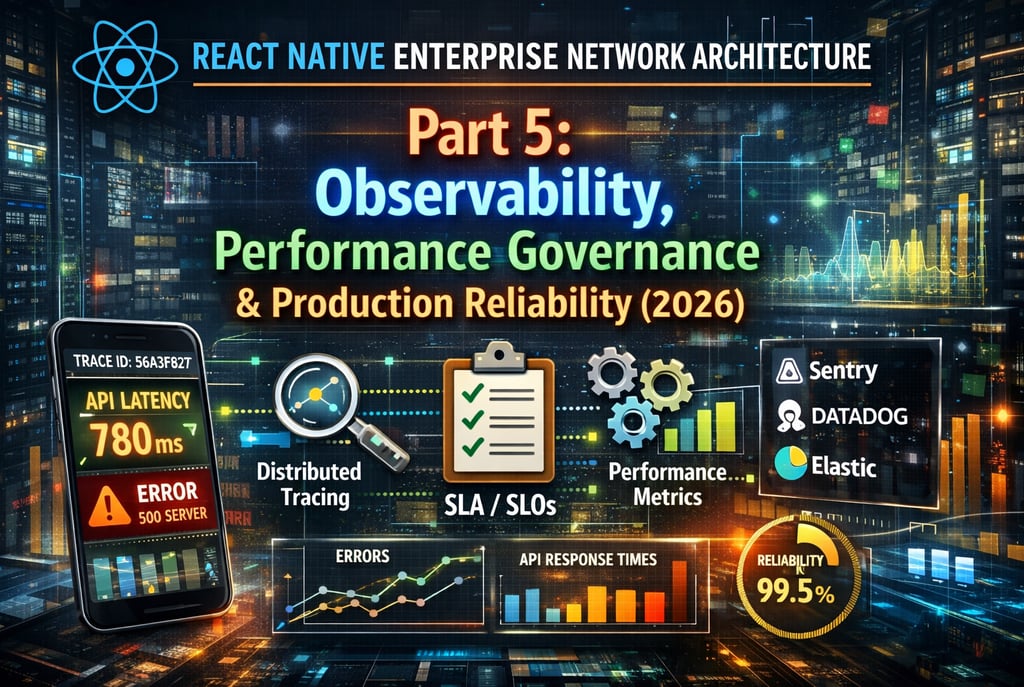
React Native Enterprise Network Architecture Part 5: Observability, Performance Governance & Production Reliability (2026)
React Native Enterprise Network Architecture Part 5 explores distributed tracing, structured logging, performance budgets, production metrics, and SLA/SLO strategies for reliable mobile systems.
ALLJAVASCRIPTREACT NATIVEREACTMOBILE DEVELOPMENTTYPESCRIPT
Part 1 built structure.
Part 2 introduced resilience.
Part 3 engineered durability.
Part 4 enabled real-time distributed systems.
Now we reach the final layer of enterprise architecture:
Production governance.
Because real systems are not defined by features.
They are defined by how well they are monitored, measured, and controlled in production.
Without observability:
Failures remain invisible
Performance regressions go unnoticed
Retry storms are misdiagnosed
Distributed systems become untraceable
Enterprise engineering requires operational visibility.
Part 5 introduces the control plane for your mobile architecture.
What We Are Building
Distributed Request Tracing
Correlation IDs Across Layers
Structured Logging Architecture
Performance Budgets for Mobile APIs
Error Taxonomy & Failure Classification
Production Metrics Layer
SLA / SLO Thinking for Mobile Systems
Enterprise Architecture Review Checklist
1️⃣ Distributed Request Tracing
Modern systems are multi-layered:
When a request fails or becomes slow, you must know:
Which endpoint failed
Which retry triggered
Which mutation caused the request
How long the entire lifecycle took
We introduce trace IDs.
🔷 Request Trace Lifecycle
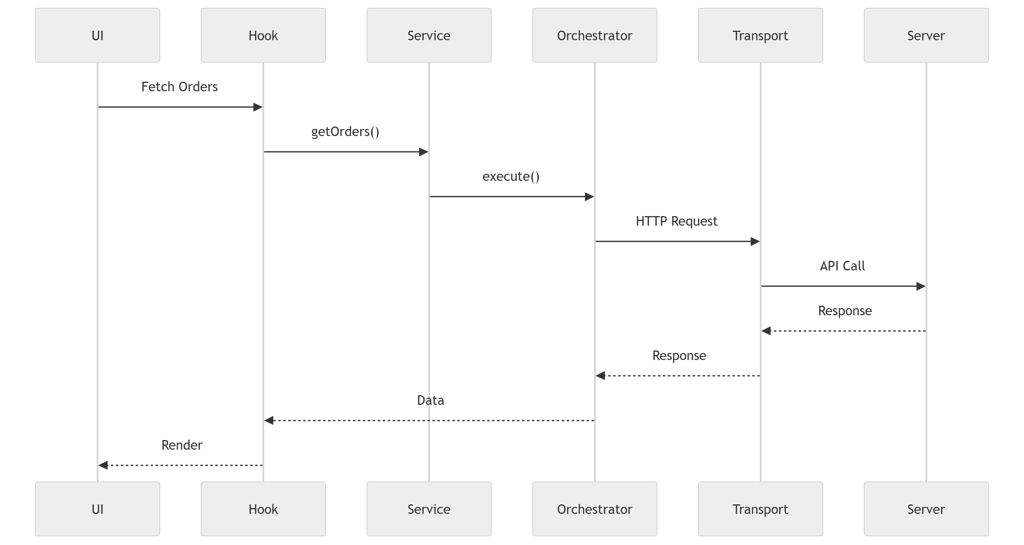
Every request gets a trace ID.
🔷 Trace ID Implementation
core/observability/trace.ts
2️⃣ Correlation IDs Across the Request Pipeline
Trace IDs must travel through every layer.
🔷 Orchestrator Integration
core/network/orchestrator.ts
3️⃣ Structured Logging Architecture
Random console logs are useless in production.
Logs must be machine-readable.
🔷 Structured Log Example
Structured logs enable integrations with:
Sentry
Datadog
Elastic
CloudWatch
🔷 Logging Layer
core/observability/logger.ts
4️⃣ Performance Budgets for API Calls
Performance should be enforced, not guessed.
Define budgets.
Example:
EndpointBudgetAuth400msOrders800msDashboard1200ms
🔷 Performance Monitor
This reveals performance regressions immediately.
5️⃣ Error Taxonomy (Failure Classification)
Not all errors are equal.
We classify them.
🔷 Error Types
TypeExampleNetwork ErrorOfflineAuthentication Error401Client Error400Server Error500Circuit BreakerBackend unstable
🔷 Error Normalization
core/network/errorNormalizer.ts
Now errors become observable metrics.
6️⃣ Production Metrics Layer
Metrics transform logs into engineering insight.
Track:
Retry counts
Circuit breaker opens
Offline mutation replays
Slow API calls
Token refresh frequency
🔷 Metrics Collector
core/observability/metrics.ts
Metrics feed monitoring dashboards.
7️⃣ SLA / SLO Thinking for Mobile Systems
Enterprise teams define service reliability targets.
Example:
MetricTargetAPI success rate99.5%Token refresh failure<0.1%Offline replay success>99%Slow request rate<2%
This transforms mobile engineering into reliability engineering.
8️⃣ Full Enterprise Architecture Lifecycle
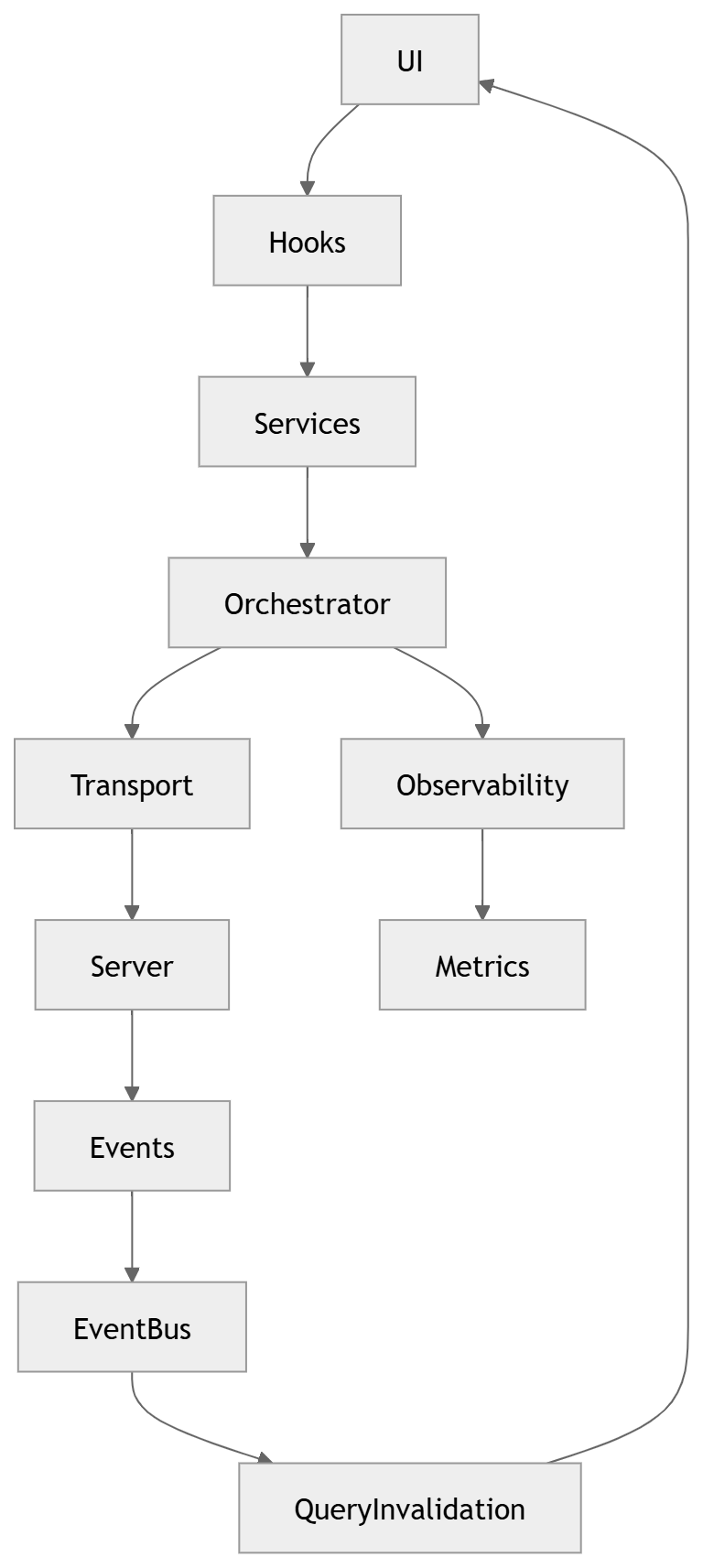
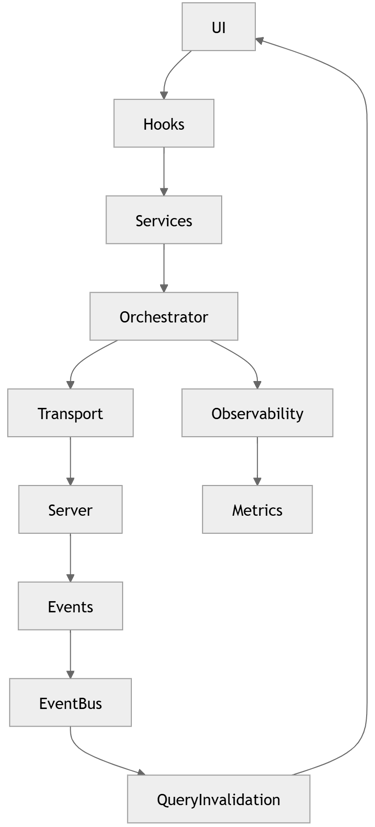
Every request now produces:
Trace data
Logs
Metrics
Performance signals
Your system becomes fully observable.
Enterprise Architecture Checklist
Your system should now support:
✅ Layered architecture
✅ Token refresh protection
✅ Client-side rate limiting
✅ Circuit breaker protection
✅ Durable offline mutation queue
✅ Background replay worker
✅ Chaos engineering validation
✅ Real-time event system
✅ Distributed state convergence
✅ Observability + tracing
✅ Performance budgets
✅ Structured logging
If these exist, your React Native client behaves like a production-grade distributed system.
Final Architecture After All 5 Parts
You now have a system capable of handling:
Token storms
Backend outages
Offline mutation replay
Background synchronization
Real-time multi-device updates
Distributed state convergence
Performance monitoring
Failure observability
Most apps make API calls.
Few engineer mobile distributed systems.
Final Thought
When you combine:
Clean architecture
Resilience engineering
Durable offline systems
Real-time distributed events
Production observability
Your mobile client stops being a UI layer.
It becomes an intelligent system node in a distributed architecture.
And that is what enterprise mobile engineering truly means.
GitHub Repository
The complete implementation of this architecture is available on GitHub.
It contains the full React Native networking control plane, including:
request orchestration
resilience systems
circuit breakers
token refresh guard
offline mutation queues
observability infrastructure
performance governance
The repository demonstrates how to build a production-grade networking layer for mobile systems, designed to handle real-world constraints like unstable connectivity, authentication expiration, and backend instability.
GitHub Repository
https://github.com/adarsh-bharadwaj/react-native-network-control-panel
You can explore the full implementation, architecture diagrams, and system components used throughout this series.
React Native Enterprise Network Architecture Series
This article is part of the React Native Enterprise Network Architecture series, which explains how to design a production-grade networking system for mobile applications.
The series walks through the full architecture step by step — from foundational layering to resilience engineering, durability systems, real-time consistency, and production observability.
Part 1 — Clean Foundation & Production Setup
Establishes the layered architecture foundation separating UI, domain hooks, services, and networking systems.
Part 2 — Token Guard, Circuit Breaker & Resilience Layer
Introduces resilience patterns including token refresh protection, rate limiting, circuit breakers, and centralized request orchestration.
Part 3 — Durability & Systems Engineering
Focuses on offline durability, mutation queues, replay engines, and safe recovery mechanisms for unreliable mobile networks.
Part 4 — Real-Time Systems & Distributed State Convergence
Explores event-driven architecture for real-time updates, event buses, and distributed state convergence inside mobile applications.
Together, these articles demonstrate how to move from feature-driven mobile apps to system-engineered mobile platforms.