
React Native Enterprise Network Architecture Part 1 – Clean Foundation & Production Setup (2026)
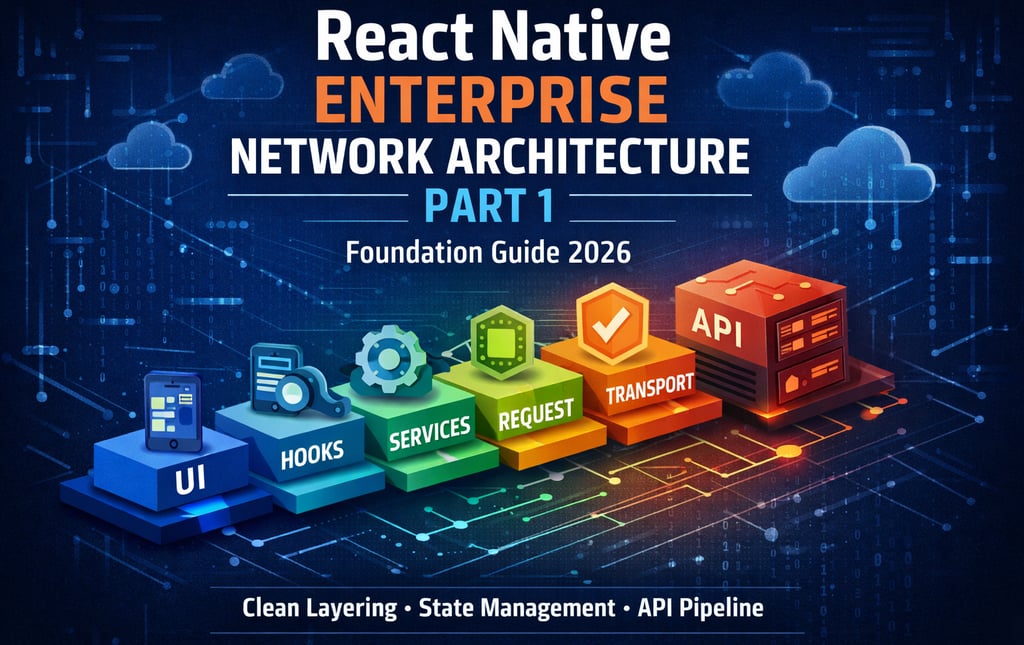
React Native Enterprise Network Architecture Part 1 guide explaining clean layering, client vs server state separation, centralized request pipeline, and production-ready API setup for scalable mobile apps.
REACTMOBILE DEVELOPMENTREACT NATIVEJAVASCRIPTTYPESCRIPTALL
Clean Layering, Server State Strategy & Production-Ready API Design
Building a serious mobile application in 2026 is not about “making API calls work.”
It’s about designing a system that behaves predictably under stress.
If your networking still looks like this inside a component:
you’re not building an enterprise application.
You’re building a demo.
In production:
APIs fail.
Tokens expire.
Requests fire in parallel.
Weak networks trigger retries.
Debugging becomes chaotic without structure.
A proper React Native enterprise network architecture Part 1 is about building the foundation correctly before adding advanced resilience patterns.
This guide focuses only on the foundation:
Clean layering
Clear responsibility boundaries
Client vs server state separation
Centralized request pipeline
Scalable folder structure
Production-ready API setup
Later parts will introduce resilience (token guards, circuit breakers, offline support). But none of that works without a solid base.
The Core Principle: Separate Responsibilities
Enterprise systems survive because each layer does exactly one job.
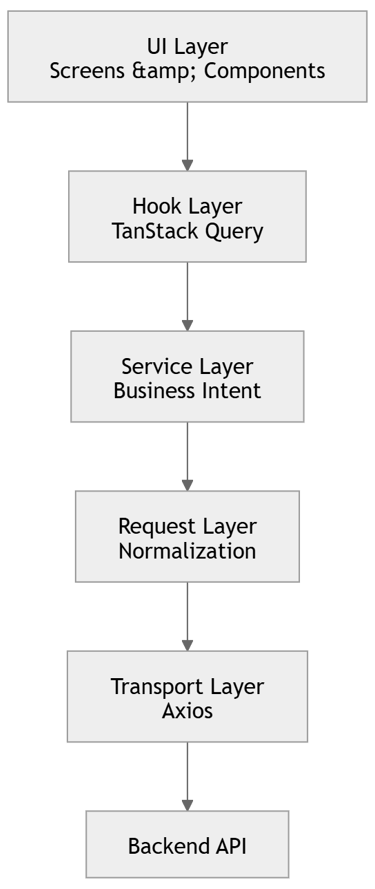
Here’s the architecture we are building.
Let’s Break This Down Carefully
1️⃣ UI Layer (Presentation Only)
This is your React Native screens and components.
It is responsible for:
Triggering data fetch
Showing loading state
Rendering data
Showing error messages
It should NOT:
Attach tokens
Retry failed calls
Normalize errors
Configure Axios
When UI handles infrastructure concerns, debugging becomes unpredictable.
2️⃣ Hook Layer (Server State Orchestration)
This is where TanStack Query lives.
It manages:
Caching
Retry logic
Background refetch
Deduplication
Stale time control
Example:
Important: This layer manages behavior, not networking details.
3️⃣ Service Layer (Business Meaning)
The service layer defines what the app wants.
Notice:
It does not import Axios.
It does not attach tokens.
It does not handle errors.
It expresses intent.
This makes testing simple and predictable.
4️⃣ Request Layer (Infrastructure Gateway)
This is the control gate.
Every HTTP call must pass here.
This centralization gives you:
Consistent error shapes
Logging insertion point
Security injection point
Future retry orchestration control
This is the heart of a production-ready React Native setup.
5️⃣ Transport Layer (Pure Networking)
This layer configures Axios only.
Transport knows about:
Base URL
Timeouts
Headers
Interceptors
It does NOT know about business logic.
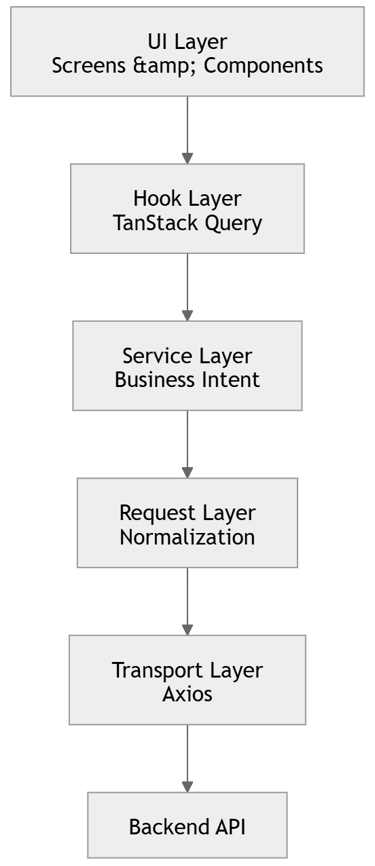
Request Lifecycle Diagram (Step-By-Step Execution)
Understanding execution flow is critical.
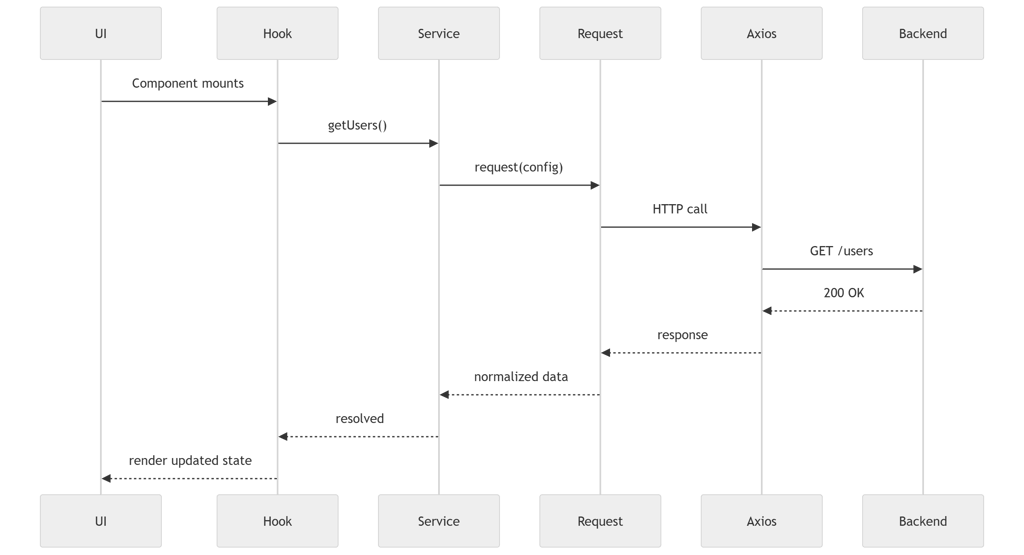
What This Flow Teaches You
Let’s trace it in plain language.
A screen loads.
The hook triggers data fetch.
The service expresses intent.
The request layer normalizes errors.
Axios performs network call.
The backend responds.
The result flows back upward.
The most important rule:
UI never directly calls Axios.
That separation is what makes scaling safe.
Client State vs Server State (Critical Separation)
One of the biggest architecture mistakes in React Native apps is using Redux for everything.
There are two types of state.
Client State (Device Only)
Authentication flag
UI toggles
Theme settings
Navigation state
Handled by Redux Toolkit:
Redux is not for server caching.
Server State (Remote Data)
Comes from API
Becomes stale
Needs caching
Needs retry logic
That’s what TanStack Query is designed for.
Mixing the two causes long-term architectural decay.
Folder Structure for Enterprise Scalability
Visual representation:


Why Dependency Direction Matters
Features depend on core.
Core never depends on features.
If you break this rule:
Circular dependencies appear
Refactoring becomes risky
Architecture slowly collapses
This small discipline prevents major long-term pain.
What Comes in Part 2
A clean architecture is only the beginning.
Real-world mobile applications must survive unpredictable production conditions:
• Expired authentication tokens
• Parallel API bursts
• Retry amplification
• Backend instability
• Weak network environments
• Offline users
• Hidden production errors
In Part 2, we will engineer the resilience layer that protects your mobile system in production.
We will implement:
Token Refresh Guards
Prevent multiple requests from triggering duplicate token refresh calls.
Request Orchestrator
A centralized pipeline that coordinates request flow across the network layer.
Client-Side Rate Limiting
Protect backend services from burst traffic originating from mobile clients.
Circuit Breaker Pattern
Stop cascading failures when backend systems become unstable.
Observability Layer
Introduce structured logging, correlation IDs, and request tracing to make production systems measurable.
These mechanisms transform a simple API client into a production-grade distributed system component.
By the end of Part 2, your mobile application will gain:
• Failure isolation
• Backend protection
• Secure token lifecycle management
• Predictable retry behavior
• Production-level observability
Because architecture is not just about clean code.
It is about systems that survive production.
GitHub Repository
The complete implementation of this architecture is available on GitHub.
It contains the full React Native networking control plane, including:
request orchestration
resilience systems
circuit breakers
token refresh guard
offline mutation queues
observability infrastructure
performance governance
The repository demonstrates how to build a production-grade networking layer for mobile systems, designed to handle real-world constraints like unstable connectivity, authentication expiration, and backend instability.
GitHub Repository
https://github.com/adarsh-bharadwaj/react-native-network-control-panel
You can explore the full implementation, architecture diagrams, and system components used throughout this series.
React Native Enterprise Network Architecture Series
This article is part of the React Native Enterprise Network Architecture series, which explains how to design a production-grade networking system for mobile applications.
The series walks through the full architecture step by step — from foundational layering to resilience engineering, durability systems, real-time consistency, and production observability.
Part 2 — Token Guard, Circuit Breaker & Resilience Layer
Introduces resilience patterns including token refresh protection, rate limiting, circuit breakers, and centralized request orchestration.
Part 3 — Durability & Systems Engineering
Focuses on offline durability, mutation queues, replay engines, and safe recovery mechanisms for unreliable mobile networks.
Part 4 — Real-Time Systems & Distributed State Convergence
Explores event-driven architecture for real-time updates, event buses, and distributed state convergence inside mobile applications.
Part 5 — Observability, Performance Governance & Reliability
Covers production observability systems, including distributed tracing, structured logging, metrics collection, and performance budgets.
Together, these articles demonstrate how to move from feature-driven mobile apps to system-engineered mobile platforms.