
React Native Enterprise Network Architecture – Part 4: Real-Time Systems, Event-Driven Consistency & Distributed State Convergence (2026)
React Native Enterprise Network Architecture Part 4 explores real-time, event-driven systems with WebSockets, distributed state convergence, multi-device sync, and conflict resolution.
ALLJAVASCRIPTREACT NATIVEMOBILE DEVELOPMENTREACTTYPESCRIPT
Part 1 → Structure
Part 2 → Resilience
Part 3 → Durability
Now we engineer something most mobile apps never properly implement:
Distributed consistency across devices in real time.
Why Real-Time Systems Fail in Production
Let’s start with a real failure scenario.
User edits an order on Device A.
Device B is open on the same account.
Admin updates price from dashboard.
Network drops briefly.
Events arrive out of order.
Without a convergence model, you get:
Stale UI
Duplicate updates
Race-condition overrides
Broken audit logs
Inconsistent multi-device state
Real-time is not about sockets.
It is about state convergence under unreliable networks.
What We’re Engineering
Centralized Real-Time Transport Layer
Domain Event Bus
Query Invalidation Strategy
Event Ordering & Missed-Event Recovery
Version-Based Conflict Resolution
Optimistic + Real-Time Reconciliation
Backpressure & Burst Protection
Full Distributed Convergence Flow
1️⃣ Real-Time Transport Layer (Infrastructure Only)
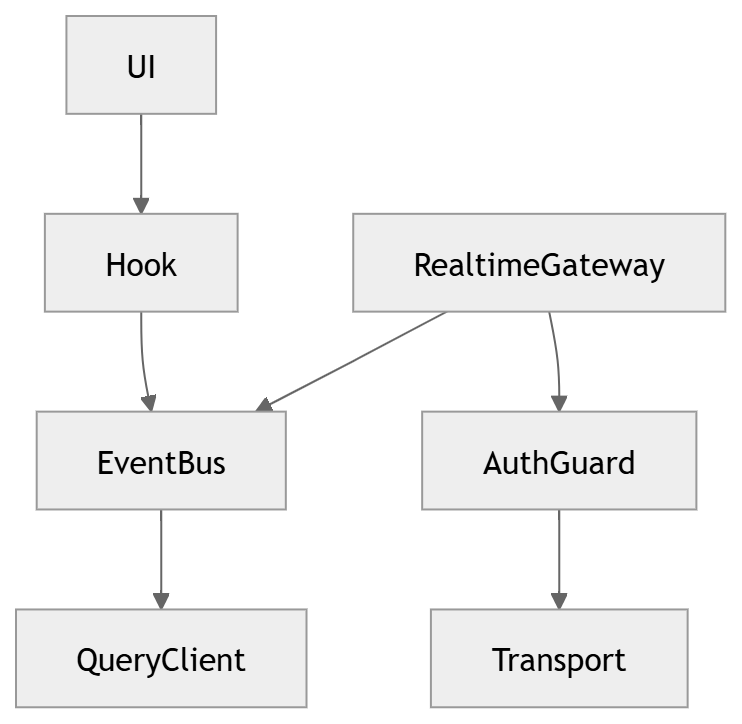
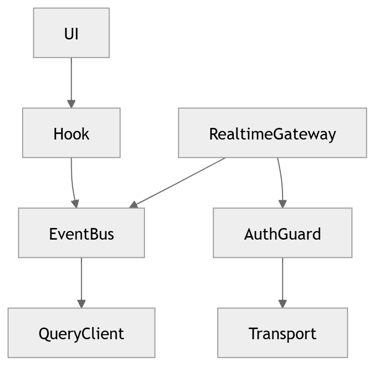
Sockets must live in infrastructure — not in UI, not in services.
📁 core/realtime/socket.ts
Why This Matters
Token injected centrally
Reconnection controlled
Transport swappable
No UI leakage
No feature coupling
This prevents architectural decay.
2️⃣ Domain Event Bus (Decoupling Real-Time from UI)
Direct socket → UI coupling is a long-term disaster.
We introduce a domain-level event system.
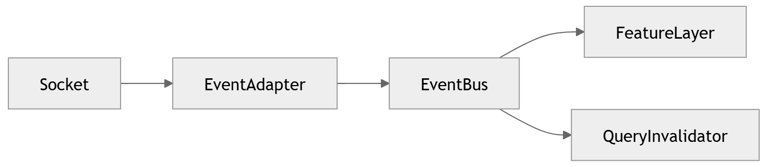
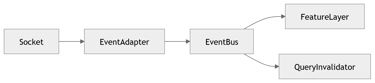
📁 core/events/eventBus.ts
Now real-time becomes:
Event → Domain Signal → Controlled Reaction
3️⃣ Authoritative State Rule
⚠ Critical Rule:
Real-time events signal change.
They do NOT carry authoritative state.
Why?
Because:
Events can be missed
Events can arrive out of order
Devices reconnect late
Horizontal scaling reorders delivery
Authoritative state always comes from API refetch.
4️⃣ Event Ordering & Missed-Event Recovery
This is where most real-time systems break.
Problem:
Device reconnects after 30 seconds offline.
It missed 12 events.
Now what?
Solution: Version Stamping
Every entity returned by backend includes:
Every event includes version:
Client logic:
If event.version > local.version → invalidate
If event.version <= local.version → ignore
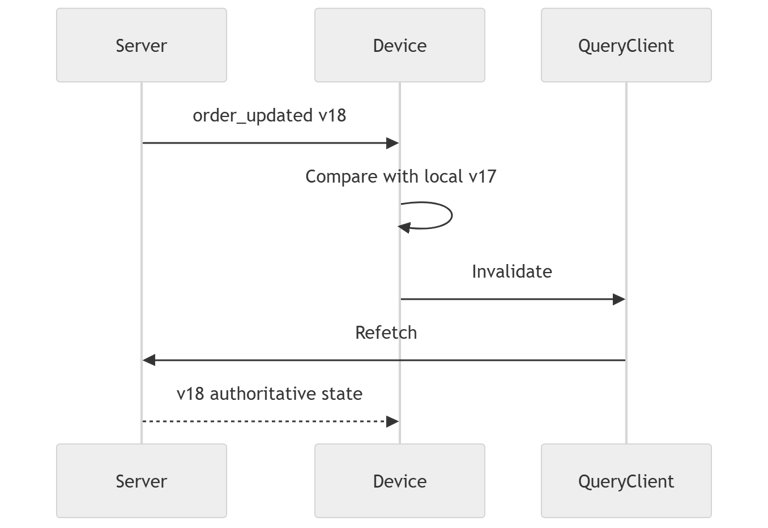
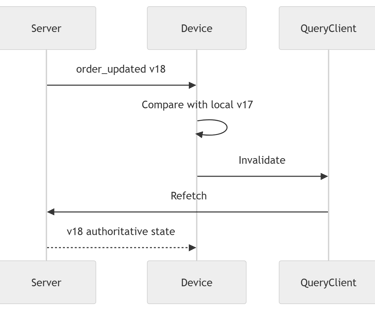
This guarantees convergence even with out-of-order events.
5️⃣ Version-Based Conflict Resolution (Mutation Safety)
Optimistic UI introduces race risk.
Example:
Device A updates profile v3 → sends version 3
Device B already updated → now version is 4
Server rejects stale write:
Client handles:
This enforces deterministic consistency.
6️⃣ Optimistic + Real-Time Reconciliation
We combine:
Optimistic mutation
Version validation
Real-time invalidation
Authoritative refetch
Result:
Even if:
Two devices update simultaneously
Admin overrides from dashboard
Socket event arrives mid-mutation
Final state converges to backend truth.
7️⃣ Backpressure & Event Burst Protection
Real-world issue:
Backend emits 200 events in 2 seconds.
If every event triggers:
You cause:
Refetch storm
Battery drain
Backend overload
Solution: Debounced invalidation
Now bursts collapse into single refetch.
8️⃣ Mobile OS Reality (Critical)
iOS and Android:
Suspend background sockets
Kill long-lived connections
Throttle network usage
Therefore:
Real-time must degrade gracefully to:
Refetch on reconnect
Background sync replay
Foreground revalidation
Sockets are enhancement — not single source of truth.
9️⃣ Full Distributed Convergence Flow
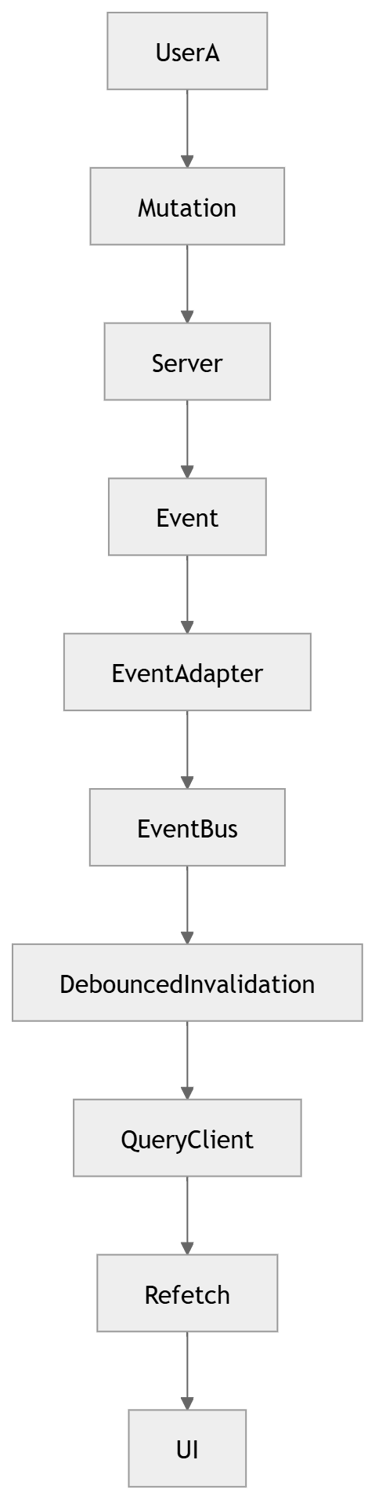
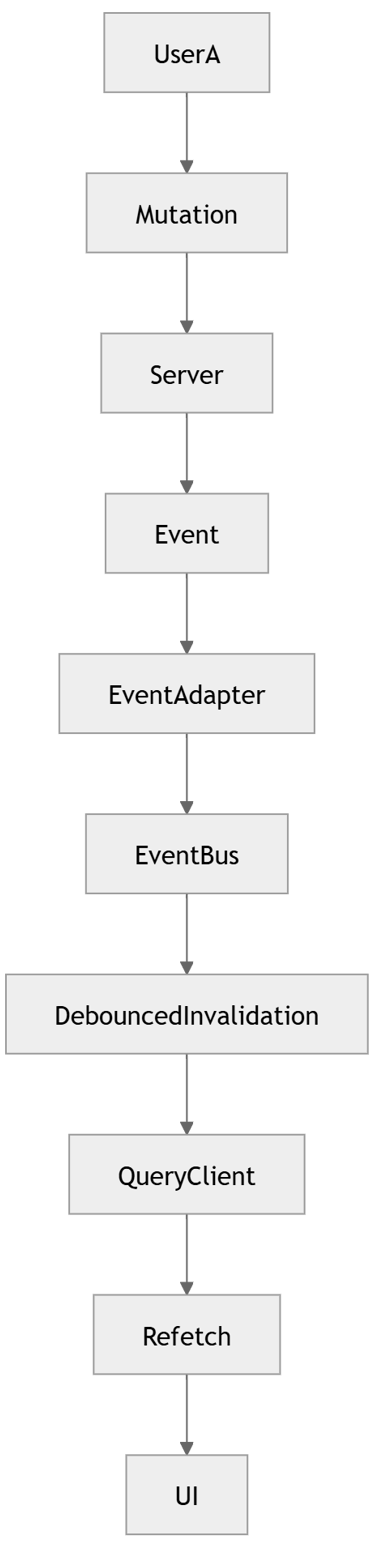
Every path leads back to:
Authoritative backend state.
Tradeoffs (Expanded)
You introduce:
WebSocket infra complexity
Backend version tracking
Increased coordination cost
Event schema contracts
Testing complexity
But you gain:
Multi-device integrity
Deterministic reconciliation
Production-grade collaboration
System observability alignment
Backend authority preservation
Tradeoffs are intentional.
After Part 4, Your System Now Handles
Real-time updates
Multi-device synchronization
Event ordering issues
Missed-event recovery
Version-safe mutations
Refetch burst control
Reconnection convergence
Distributed state reconciliation
This is no longer:
“React Native networking.”
This is:
Distributed systems engineering inside a mobile runtime.
Final Thought
Most mobile apps:
Fetch.
Retry.
Cache.
Few engineer convergence.
When you implement:
Version stamping
Deterministic conflict handling
Debounced invalidation
Missed-event recovery
Authoritative refetch convergence
You stop thinking in screens.
You start thinking in distributed state machines.
That is the difference between:
Senior developer
and
System architect.
🔭 Coming Next: Part 5 — Production Observability & Performance Governance
The final part of this series introduces the operational control layer for enterprise mobile systems.
We will cover:
• Distributed request tracing
• Cross-layer request correlation
• Structured production logging
• Performance budgets for mobile APIs
• Runtime slow request detection
• Error taxonomy & failure classification
• Production metrics collection
• SLA / SLO thinking for mobile reliability
• Enterprise architecture review checklist
This transforms a React Native client from a UI layer into a fully observable distributed system node.
GitHub Repository
The complete implementation of this architecture is available on GitHub.
It contains the full React Native networking control plane, including:
request orchestration
resilience systems
circuit breakers
token refresh guard
offline mutation queues
observability infrastructure
performance governance
The repository demonstrates how to build a production-grade networking layer for mobile systems, designed to handle real-world constraints like unstable connectivity, authentication expiration, and backend instability.
GitHub Repository
https://github.com/adarsh-bharadwaj/react-native-network-control-panel
You can explore the full implementation, architecture diagrams, and system components used throughout this series.
React Native Enterprise Network Architecture Series
This article is part of the React Native Enterprise Network Architecture series, which explains how to design a production-grade networking system for mobile applications.
The series walks through the full architecture step by step — from foundational layering to resilience engineering, durability systems, real-time consistency, and production observability.
Part 1 — Clean Foundation & Production Setup
Establishes the layered architecture foundation separating UI, domain hooks, services, and networking systems.
Part 2 — Token Guard, Circuit Breaker & Resilience Layer
Introduces resilience patterns including token refresh protection, rate limiting, circuit breakers, and centralized request orchestration.
Part 3 — Durability & Systems Engineering
Focuses on offline durability, mutation queues, replay engines, and safe recovery mechanisms for unreliable mobile networks.
Part 5 — Observability, Performance Governance & Reliability
Covers production observability systems, including distributed tracing, structured logging, metrics collection, and performance budgets.
Together, these articles demonstrate how to move from feature-driven mobile apps to system-engineered mobile platforms.