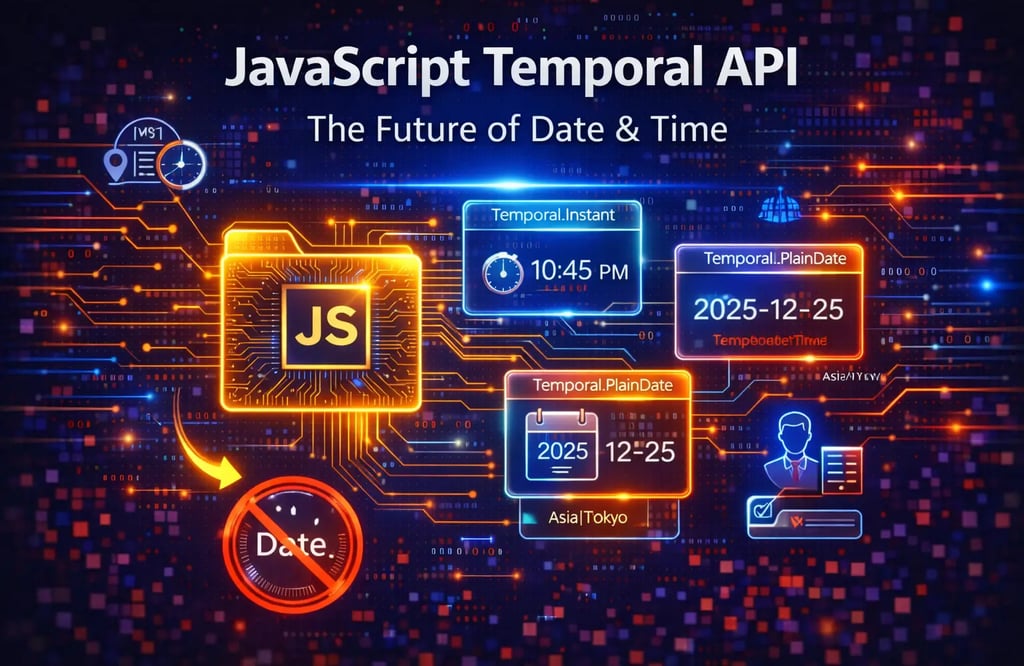
JavaScript Temporal API: The Future of Date & Time
JavaScript Temporal API is set to replace the flawed Date object, offering precise time zones, better formatting, and safer date handling for modern web applications in 2025 and beyond.
ALLJAVASCRIPTTECH NEWSWEB DEVELOPMENT
JavaScript developers have complained about one thing consistently for years — working with dates and time is painful. The built-in Date object is confusing, mutable, error-prone, and unreliable across time zones.
That’s finally changing.
The JavaScript Temporal API is one of the most anticipated and trending additions to the JavaScript language, and it’s gaining massive attention as we approach the end of 2025. Many developers and frameworks are already preparing for it — making this topic highly shareable and viral.
Let’s break down why Temporal matters, how it works, and why every JavaScript developer should care.
❌ Why JavaScript Date Was a Problem
The existing Date object suffers from multiple issues:
Months start at 0 instead of 1
Mutable behavior causes bugs
Confusing time zone conversions
Poor internationalization support
Hard-to-read APIs
Example:
new Date(2025, 11, 25) // December? Actually yes… but confusing!
These issues lead to bugs in:
scheduling apps
financial systems
international products
analytics dashboards
✅ What Is the JavaScript Temporal API?
The JavaScript Temporal API is a modern date-and-time system designed to completely replace Date.
It introduces clear, immutable, and predictable objects such as:
Temporal.PlainDate
Temporal.PlainTime
Temporal.ZonedDateTime
Temporal.Instant
Each object has a single responsibility, making code easier to understand and maintain.
🧠 Key Advantages of Temporal API
1️⃣ Immutability (No More Side Effects)
Temporal objects never mutate.
const today = Temporal.Now.plainDateISO(); const tomorrow = today.add({ days: 1 });
No unexpected changes. No bugs.
2️⃣ Built-In Time Zone Safety
Time zones are first-class citizens in Temporal.
Temporal.Now.zonedDateTimeISO("Asia/Kolkata");
Perfect for:
global apps
remote teams
finance & travel platforms
3️⃣ Clear Date vs Time Separation
Temporal separates concepts clearly:
Date only → PlainDate
Time only → PlainTime
Date + time + zone → ZonedDateTime
This removes confusion entirely.
🔥 Why This Topic Is Trending in 2026
The JavaScript Temporal API is trending because:
It’s entering stable browser support
Frameworks like React, Angular, and Vue are preparing adoption
Developers are tired of Moment.js and workarounds
Interviewers are starting to ask about it
Many tech influencers are already calling it:
“The most important JavaScript upgrade since async/await.”
💼 Impact on Interviews & Careers
Knowing Temporal gives you an edge:
Shows modern JavaScript knowledge
Helps explain real-world time zone problems
Makes system design answers stronger
Signals senior-level awareness
Expect questions like:
“How would you handle dates safely across time zones?”
🔮 What Happens Next?
Libraries like Moment.js will fade further
Native Temporal adoption will rise
Cleaner, safer JavaScript codebases
Better global apps
If you’re learning JavaScript in 2025, Temporal is non-negotiable.
✅ Final Thoughts
The JavaScript Temporal API fixes one of JavaScript’s oldest pain points. It’s modern, powerful, and built for real-world applications.
Whether you’re:
preparing for interviews
building production apps
creating content
teaching JavaScript
This is a topic you must understand early.