
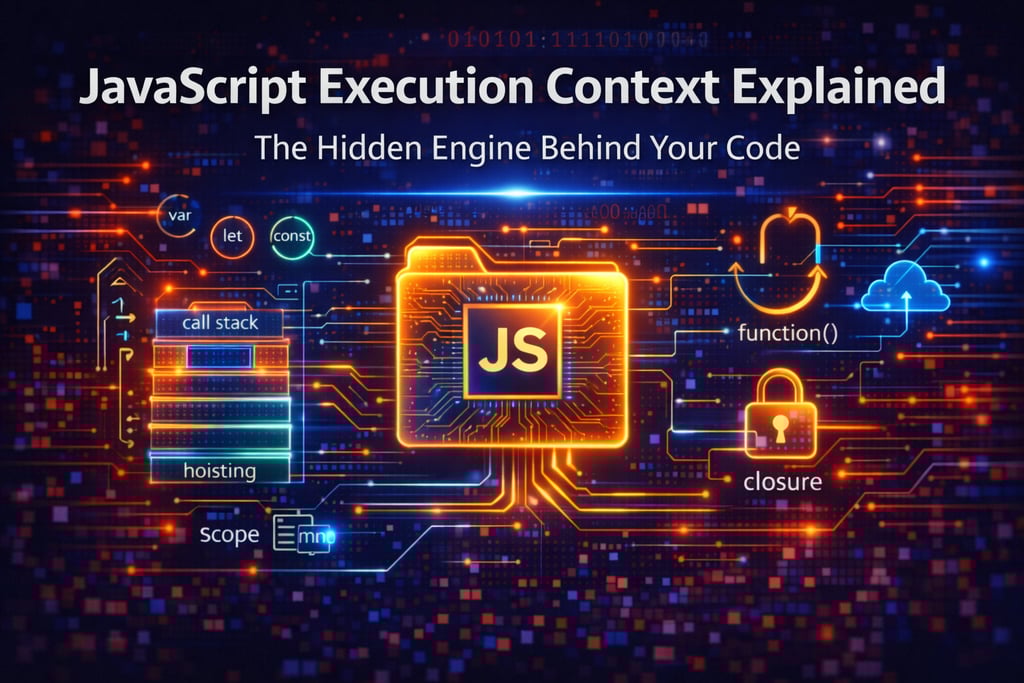
JavaScript Execution Context Explained — The Hidden Engine Behind Your Code
The JavaScript Execution Context plays a crucial role in how code runs, manages memory, handles scope, hoisting, closures, and the call stack. This in-depth guide explains how execution context works in real-world coding scenarios, interview questions, and performance optimization in modern JavaScript
ALLAI/MLTECH NEWS
If you’ve ever wondered why some JavaScript programs behave differently than expected — especially when dealing with variables, functions, scope, hoisting, or closures — the answer almost always comes down to one thing:
👉 The JavaScript Execution Context
It is the invisible engine inside JavaScript that decides:
how code is executed
how memory is allocated
how variables and functions are stored
how scope and closures work
how the call stack processes functions
Yet most developers never learn it deeply — until an interview question, production bug, or tricky async behavior forces them to.
In 2025, with JavaScript powering AI dashboards, real-time apps, mobile frameworks, and large-scale systems, understanding execution context is not just theory — it’s a career-boosting skill.
This blog breaks it down in the simplest, most practical way — with real-world explanations and examples.
What is the JavaScript Execution Context?
Whenever JavaScript runs code, it creates an Execution Context.
Think of it as a container where:
✔️ variables live
✔️ functions are stored
✔️ scope is tracked
✔️ memory is managed
There are three main types:
1️⃣ Global Execution Context (GEC)
Created when a program starts
2️⃣ Function Execution Context (FEC)
Created whenever a function is called
3️⃣ Eval Execution Context (rarely used today)
Every execution context goes through two phases:
Phase 1 — Creation Phase (Memory Allocation)
JavaScript scans the code before running it.
During this phase:
variables are stored in memory
functions are stored as references
var is initialized as undefined
let and const enter the Temporal Dead Zone
This is why hoisting happens.
Example:
console.log(a); var a = 10;
Output:
undefined
Because memory was allocated before execution.
But:
console.log(b); let b = 10;
This throws:
ReferenceError
let & const are not accessible during TDZ.
Phase 2 — Execution Phase
Now JavaScript actually runs the code, line by line.
values are assigned
functions are executed
expressions are evaluated
If a function is called — a new Function Execution Context is created and pushed onto the Call Stack.
Call Stack — The Brain of JavaScript Execution
The call stack works on:
👉 LIFO (Last In, First Out)
Example:
function one() { two(); } function two() { console.log("Inside function two"); } one();
Execution order:
1️⃣ Global Context created
2️⃣ one() pushed
3️⃣ two() pushed
4️⃣ two() executed & removed
5️⃣ one() executed & removed
6️⃣ Program finishes
Understanding this helps debug:
recursion bugs
stack overflow errors
nested function execution
Execution Context & Scope Chain
Each execution context has its own:
✔️ Local scope
✔️ Outer lexical environment
✔️ Access to global scope
If a variable is not found locally — JavaScript looks outward.
Example:
let x = 10;
function test() {
console.log(x);
}
test();
x is not inside test()
So JavaScript checks outer scope — and finds it.
This is called the:
👉 Scope Chain
Closures — Execution Context That Stays Alive
Closures happen when:
A function remembers variables from its parent context — even after the parent has finished executing.
Example:
function counter() {
let count = 0;
return function () {
count++; console.log(count);
}; }
const increment = counter();
increment();
increment();
increment();
Output:
1 2 3
The variable count stays alive because:
👉 The inner function retains its execution context
This is used in:
React hooks
Event handlers
Private variables
Functional programming patterns
Closures are one of the most asked interview topics — and deeply tied to execution context.
Hoisting, Var vs Let, and Execution Behavior
Because of execution context:
var is hoisted & initialized as undefined
let and const are hoisted but not initialized
functions are stored in memory before execution
Example:
sayHello();
function sayHello() {
console.log("Hello World");
}
Works fine — because function declarations are fully hoisted.
But:
greet(); var greet = function () { console.log("Hi"); };
Throws:
TypeError: greet is not a function
Because greet was initialized as undefined.
Execution context explains this behavior perfectly.
Real-World Developer Scenarios
Execution context affects:
✔️ asynchronous code
✔️ event loop handling
✔️ debugging stack traces
✔️ React render behavior
✔️ Node.js request handling
Engineers who understand it:
write more predictable code
debug issues faster
perform better in interviews
That’s why execution context knowledge separates:
👉 beginners from professionals
Final Thoughts — Why This Topic Matters in 2025
JavaScript is no longer a “browser scripting language”.
It powers:
mobile apps
AI dashboards
fintech systems
cloud platforms
multi-platform frameworks
And as systems grow — so does execution complexity.
Understanding the JavaScript Execution Context is like understanding a car engine:
You don’t just drive better —
You think like an engineer.
Summary of Key Takeaways
Execution context controls how JavaScript runs code
It has creation & execution phases
The call stack manages function order
Scope chain resolves variable lookup
Closures exist because execution context persists
Hoisting behaves differently for var, let, const
Master this — and JavaScript stops being confusing.
It becomes predictable.