AI Regulation Rules 2025: New Global Laws Transform Tech Industry
AI Regulation Rules 2025 lead today’s trending tech news as governments around the world roll out new laws to govern artificial intelligence use, reshaping innovation, privacy, and corporate compliance across industries.
ALLAI/MLTECH NEWS
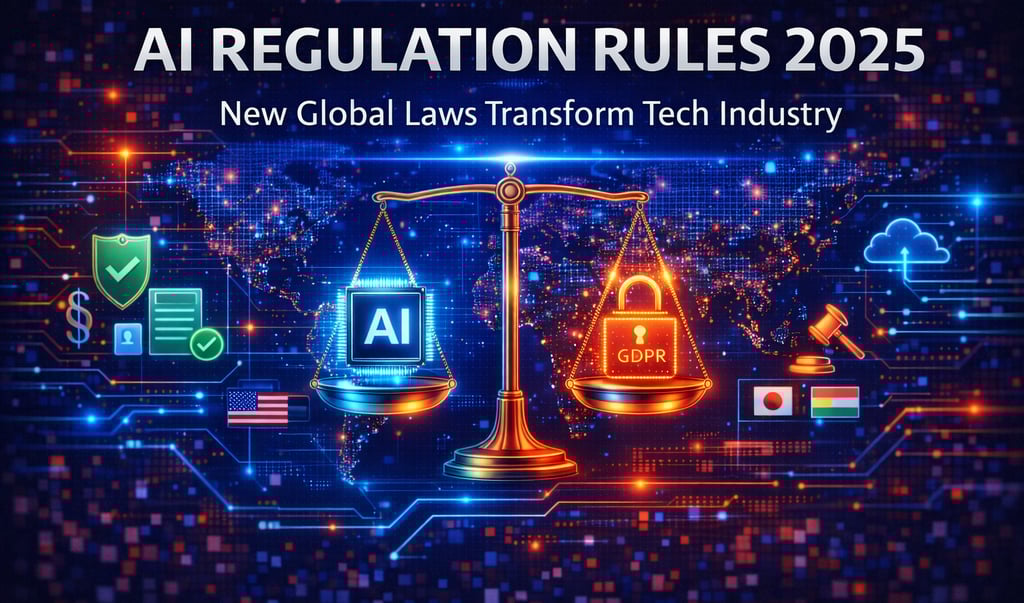
Governments around the world are moving rapidly to regulate artificial intelligence — and the result is a landmark shift in technology, business practice, and consumer protection. The AI Regulation Rules 2025 are dominating today’s headlines and sparking intense discussions in boardrooms, regulatory forums, and coder communities alike.
This historic wave of regulations is shaping how AI can be developed, deployed, and monetized across virtually every industry — from healthcare and finance to autonomous driving and digital media.
In 2025, lawmakers aren’t just talking about AI — they’re acting.
A New Era of AI Governance
AI technology has grown at an extraordinary pace — far faster than laws governing its use. As a result:
Governments worried about safety, bias, and ethics
Consumers demand protection from misuse
Enterprises need predictable compliance frameworks
In response, nations including the United States, European Union members, India, Japan, and Australia have either passed or are finalizing comprehensive AI governance frameworks collectively known as the AI Regulation Rules 2025.
These regulations cover areas such as:
✔ AI transparency and explainability
✔ Data privacy and security safeguards
✔ Ethical use and human oversight
✔ Consumer rights around automated decisions
✔ Corporate compliance and accountability
This shift is already reshaping how companies build AI into their products and services.
Why the AI Regulation Rules 2025 Matter
Previously, many companies could deploy AI with minimal oversight — especially in areas such as recommendation systems, content analytics, automated decision-making, and predictive modeling.
But with 2025’s new legal frameworks:
Businesses must clearly disclose when AI is interacting with humans
Sensitive data usage requires consent and audit trails
High-risk AI systems (like autonomous vehicles and medical diagnosis) face stringent testing
Algorithms must be explainable and finally accountable
This marks a generational change — similar to when internet privacy laws matured in the early 2000s.
How Different Regions Are Approaching AI Regulation
🇪🇺 European Union
The EU has long been at the forefront of tech regulation. Its AI Act of 2025 sets strict guidelines for “high-risk AI” and mandates compliance reporting, impact audits, and continuous monitoring.
Key points include:
Mandatory risk assessments
Transparency disclosures for AI decisions
Consumer protections for automated systems
This model will likely influence many Asian and African regulatory frameworks in the coming years.
🇺🇸 United States
The U.S. approach focuses on balancing innovation with risk mitigation. New federal guidelines emphasize:
Safe AI development standards
Industry-wide best practices
Anti-discrimination protocols
Agencies such as the FTC and NIST will provide oversight and auditing standards for AI governance.
🇮🇳 India
India’s AI policy emphasizes inclusive innovation, data sovereignty, and ethical risk frameworks. The regulations support domestic AI startups while ensuring user safety — a strategic blend of innovation and protection.
India becomes one of the world’s top emerging markets for ethical AI deployment.
What Companies Must Do Now
If your organization relies on AI — whether for product development, analytics, or customer engagement — these new laws require immediate action.
🔹 1. Conduct an AI Risk Audit
Identify AI systems across departments and assess:
Potential bias
Data privacy compliance
Usage in high-risk decision systems
🔹 2. Develop Transparency Protocols
Explainability isn’t optional:
Users must understand when and how AI impacts decisions
Documentation is now legally required
🔹 3. Establish Governance Teams
Many firms are creating internal AI ethics and compliance teams — similar to data protection and security functions — with dedicated leadership for AI accountability.
Impact on Consumers
For consumers, the AI Regulation Rules 2025 mean:
Clearer information when AI affects credit decisions, job screening, and insurance
Rights to appeal automated decisions
Better safety for autonomous systems and medical AI
In essence, AI will no longer feel invisible — its decisions, consequences, and risk profiles will be transparent and accountable.
Industry Reactions
Tech leaders have responded with a mix of enthusiasm and caution:
✔ Some applaud the clarity and confidence it brings
⚠ Others worry about compliance costs and slower innovation cycles
However, many experts believe that predictable regulation fosters trust, and trust attracts broader adoption — especially from enterprise customers.
AI Regulation Rules 2025 — What This Means for the Future
As 2025 comes to a close, the landscape of technology is shifting from:
🔹 Wild growth and experimentation
to
🔸 Responsible, accountable, law-aligned innovation
AI will continue evolving — but now within a framework that protects users, encourages transparency, and anchors tech’s growth in ethical standards.
With the AI Regulation Rules 2025, the global community is signaling:
Innovation must be balanced with responsibility.
And that’s a message the world will carry into the next decade.
Frequently Asked Questions (FAQs)
What are the AI Regulation Rules 2025?
They are a set of new global laws designed to govern AI systems for safety, transparency, and ethical deployment.
Do these rules affect all AI systems?
Yes — especially those used in high-risk areas like healthcare, finance, and autonomous systems.
Are developers required to explain AI decisions?
Yes, explainability and documentation are mandatory for regulated systems.